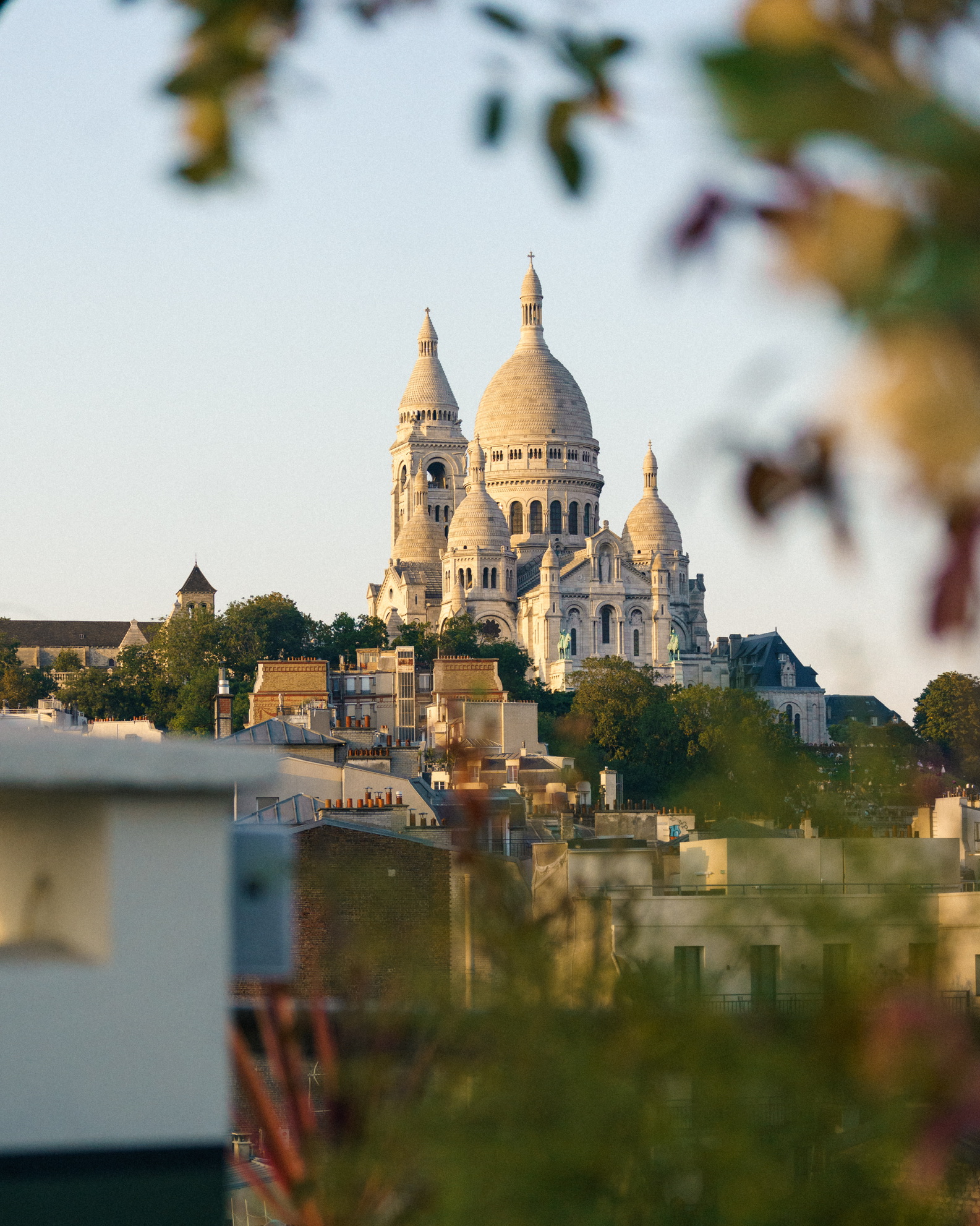
Sacré-Cœur at golden hour, Paris
Table 1A  ·  No. 05
2nd  ·  10th  ·  18th arrondissement

Paris.

The back of the Sacré-Cœur, a baba au rhum, and a rooftop you won't want to leave.

48.8566° N · 2.3522° E
May 2026
Business class from ORD · 65k Flying Blue

The city that rewards
the second glass.

"The trick with the Sacré-Cœur is not to stand in front of it. Turn around — and find the grass on the north side of the basilica, the side nobody photographs."

Walk past the artists who will loop a friendship bracelet around your wrist before you've agreed to anything, and find the grass on the north side of the basilica — the side that deposits you into a quieter square with a small vineyard and the specific feeling of having taken a wrong turn into someone's actual neighborhood. Lay something down. Open whatever you bought at Terroirs d'Avenir an hour ago. Watch the city arrange itself below you in that particular afternoon light that makes the whole thing look like it was placed there on purpose, which it was, in a way, over nine hundred years.

The 18th has been described as "up and coming" for so long that it has simply become. The tourists still cluster on the front steps. The galleries near the place du Tertre are a mixed bag — some cynical, some genuinely serious — but the street artists who work the narrow passages toward the Rue Lepic are doing something older and stranger than tourism, which is making work in public because they cannot afford to stop.

The carousels at the foot of the Butte have been spinning children in circles since before your grandparents were born. Paris maintains certain rituals past any reasonable justification. The carousels are one of them.

This issue is about a specific Paris — the one that starts at the 10th's canal and climbs through Pigalle into the 18th without demanding your full attention. The city that rewards people who look up, slow down, and order the second glass. This is a special one.

Three arrondissements. Four restaurants worth rerouting for. One grower Champagne that earns a place on your list immediately. And the points play that gets you here in a lie-flat seat without paying for it.

Flying Business Class
to Paris from O'Hare

Without paying for it.

65k Flying Blue miles · ORD–CDG · Business
50k Virgin Atlantic points · Delta One · One way
1:1 Chase & Amex transfer ratio to both programs

Air France operates a daily nonstop ORD–CDG, and that flight is the backbone of the best award redemption out of Chicago. Book it through Air France Flying Blue at approximately 65,000 miles one way in business class — and sometimes less during their monthly Promo Rewards sales, which have historically dropped this specific route to as low as 50,000 miles. Flying Blue is a dynamic program, meaning prices move, but the ORD–CDG nonstop is one of the more consistent values in the program. The hard product on Air France's 777 is genuine business class — lie-flat, direct aisle access — not the recliner-in-nice-clothes that gets passed off as premium on shorter hauls.

If Flying Blue inventory is thin, the second play: Delta One on the ORD–CDG codeshare, bookable through Virgin Atlantic Flying Club at 50,000 points one way — still one of the last fixed-rate redemptions standing after years of devaluation across every other program. Virgin Atlantic transfers from Chase Ultimate Rewards, Amex Membership Rewards, Capital One, and Citi at 1:1, meaning a single strong welcome bonus covers two business-class seats to Paris with points left over. British Airways Avios via Iberia can also work for connecting itineraries through Heathrow if the nonstop is sold out in points space.

For building the points, the Chase Sapphire Reserve and the Amex Platinum are both doing the necessary work here — each transfers 1:1 to Flying Blue and Virgin Atlantic. The Reserve's 3x on travel and dining means anyone eating seriously in Chicago is quietly accumulating Paris business class without a spreadsheet. Amex runs transfer bonuses to Flying Blue a few times a year; catch one, and a single welcome offer becomes 75,000–80,000 miles.

Four places
worth knowing about.

Wine Bar
Bien Élevé

Lower 9th, just off the Rue des Martyrs — one of the serious natural wine bars in Paris, not in a precious way but in the way where the person pouring has actually read the producer's notes and wants to discuss them. The list rotates fast, the space is small, and the food is exactly as good as it needs to be and nothing more.

→ Go Tuesday or Wednesday. Ask what just arrived — there's usually something open that isn't on the written list.
Restaurant
La Beauce

A proper bistro in the 2nd that operates as though the last thirty years of Parisian dining trends simply never arrived, which in context is entirely a compliment. The prix-fixe at lunch is still the organizing principle, the wine list has bottles you haven't seen anywhere else at prices that read like a misprint, and the steak frites is the version against which all other steak frites should be measured.

→ Order the terrine to start. It arrives looking modest and tastes like someone made it that morning, which they did.
Hidden Gem
Stohrer

The oldest pâtisserie in Paris, opened in 1730 on the Rue Montorgueil by the pastry chef of Louis XV — a fact that every guidebook mentions, and that somehow hasn't managed to ruin the place. The baba au rhum here is the original recipe, and it is the only version that justifies the existence of the dessert as a concept.

→ Don't take it to go. Eat it at the small counter inside. The rum is applied tableside from a bottle that looks older than the Fifth Republic.
Restaurant
Brach Paris

Philippe Starck's hotel restaurant in the 16th is not what you expect from a Starck property — the room is theatrical but the food is focused, and the rooftop terrace operates in warm months with a view of Paris that feels deliberately omitted from the guidebook circuit. The kitchen's vegetable work is serious in a way that doesn't announce itself.

→ Book the rooftop separately from the dining room if needed — the bar menu alone is worth crossing the river.

One wine.
Understand it.

Ultradition
Laherte Frères  ·  Marne Valley, Champagne  ·  NV

Most grower Champagne has quietly abandoned four of the seven traditional varieties of the appellation — Arbane, Petit Meslier, Pinot Blanc, and Auxerrois — because they're labor-intensive, low-yielding, and genuinely difficult to work with. Laherte Frères, a sixth-generation family domaine farming organically in the Marne Valley, put all seven into a single cuvée and named it "Ultradition." The result makes a fairly convincing case that those varieties weren't cut because they made the wine worse.

The blend achieves a layered complexity that single-varietal expressions structurally cannot — a mineral freshness underneath, a richer middle weight from the Pinot Blanc and Auxerrois, and a finish that keeps going after you've stopped paying attention to it. Open it colder than you think necessary. Give it twenty minutes in the glass before you commit to an opinion — it starts tight and almost saline, then opens into something rounder and faintly textured.

Drink it with something salty: Brittany oysters, a jambon-beurre from a source you trust, whatever cheese you carried back from the market and have been eating over the sink. It is specifically the Champagne for a Paris evening when you are not celebrating anything in particular, which somehow makes it the right bottle every single time. In the US, distributed through Skurnik Wines. Find it at Chambers Street Wines in New York or ask your local shop to source it directly.

Retail $55–75 · Buy two when you see it
18

What the 18th
keeps to itself.

Montmartre · Pigalle · Lamarck-Caulaincourt

Every first-time visitor approaches from Anvers and fights up the front steps with the rest of the world. The view from behind is the one Parisians know.

Every first-time visitor to Montmartre approaches from the Anvers métro and fights up the front steps with the rest of the world. The view from the front is famous; the church is fine. The view from behind — the north side, the Rue du Mont-Cenis side — is the one that Parisians know, the one that deposits you into a quieter square with a small vineyard and the specific feeling of having taken a wrong turn into someone's actual neighborhood. The Clos Montmartre produces roughly 1,500 bottles a year, most of it auctioned for charity, little of it worth drinking. That is beside the point. The point is that vines grow in Paris, that in October the entire block smells of must, and that almost nobody ascending the front steps knows this is happening fifty meters away.

Serious locals in the 18th do not eat breakfast on the hill. They descend. The Rue Lepic market, the boulangeries along the Rue des Abbesses, the ritual of buying something and eating it while moving — this is the actual morning. Tourist Paris and local Paris divide cleanly around 9am: one is queueing at a crêpe stand near the place du Tertre while the other is already on a second coffee at a counter café with no English menu and no presence anywhere online.

For where to stay in this part of the city, two hotels have earned their place. Hôtel de Nell, in the quiet upper 10th near the Rue du Faubourg-Poissonnière, is a serious design hotel that treats its guests as adults — restrained, precise, genuinely silent at night, with a bar worth staying in rather than leaving. Hôtel Rochechouart sits at the exact border of the 9th and 18th, at the intersection where Pigalle-as-entertainment-district meets Pigalle-as-actual-neighborhood, and it has figured out how to serve both without compromising either. The rooms are smaller than the photographs suggest. The location compensates for every square meter.

The moment Paris stops feeling like a trip and starts feeling like something else happens differently for everyone. In this neighborhood it usually involves Pigalle on a weekday after 9pm — the wine bars and late-night kitchen restaurants and the low-frequency understanding that you are in a city where some people actually live this way every week, where Tuesday at 11pm in a small room with a serious list is not an occasion, just a Tuesday. On the walk back you'll pass one of the old carousels at the foot of the Butte, locked for the night, still lit, turning for nobody. You'll stop. You'll remember precisely where you are.

Three things
before you go.

01

Terroirs d'Avenir's boulangerie on the Rue du Nil has been making the case for heritage grain bread since before it was a talking point — if you've spent years eating baguette tradition in Paris and still haven't tried their pain de campagne, you have been operating on incomplete information.

02

The carousels at the foot of the Butte — several of them, at different elevations, maintained by the city since the 19th century — are one of the few experiences in Paris that cost almost nothing, take exactly as long as a child needs them to, and deliver precisely what they promise, which turns out to be quite a lot.

03

La Beauce's lunch prix-fixe is one of the last honest deals left in the 2nd — three courses at a price that would barely cover a glass of wine at the kind of Paris restaurant that keeps an English menu in the window and considers that hospitality.

Your seat
is ready.

Both publications. Free. Every week.

No spam. Unsubscribe at any time.